
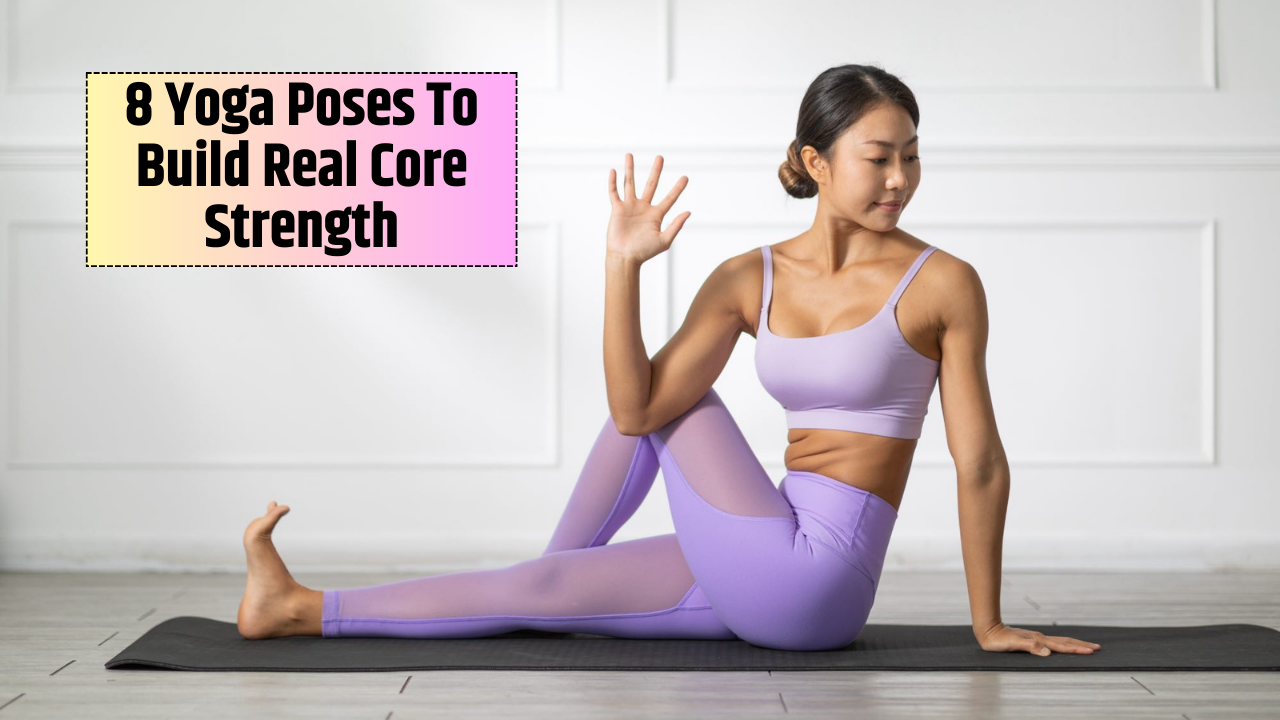

A strong core is one of those things people talk about casually usually in the context of “getting abs” but its real influence runs much deeper. A stable core protects your lower back, sharpens posture, enhances balance, and quietly supports almost every move you make, from carrying groceries to standing in a long line. And yet, I’ve watched people commit to endless crunches with little to show for it besides neck strain and frustration. The missing ingredient is often functional strength—the kind that trains not just surface muscles but the deeper stabilizers you don’t see in the mirror.
Yoga fills that gap beautifully. With slow holds, controlled transitions, and full-body engagement, it strengthens the abdominal wall from every angle. This eight-pose routine can be done at home in about 20 minutes, no equipment needed, and it hits the muscles that matter most for real-world strength.
Plank Pose
Start on hands and toes, shoulders stacked directly over wrists, body long and straight.
Plank fires up the entire core, especially the transverse abdominis—the muscle that wraps around your torso like a natural support belt. Hold for 20 to 40 seconds. Keep the hips level and resist the temptation to sag. Steady breathing keeps the body from tensing unnecessarily.
Side Plank
From Plank, rotate onto one hand and stack your feet. Lift your top arm toward the ceiling.
Side Plank targets the obliques, the muscles responsible for rotational stability and side-body strength. Hold for 20 to 30 seconds per side. If balance wobbles, drop the bottom knee for a supported variation.
Boat Pose
Sit, lift your legs, and balance on your sitting bones. Arms reach forward, spine stays tall.
Boat Pose hits the front abdominals and hip flexors directly. The shake you feel here? That’s the good stuff—muscles waking up and doing their job. If your lower back rounds, bend your knees slightly. Hold for five to eight deep breaths.
Forearm Plank
Lower onto your forearms, elbows aligned under shoulders, body straight and strong.
This variation reduces wrist strain but ramps up core demand. Press your forearms firmly into the ground and keep your hips from drifting up or collapsing downward. Aim for a 30–40 second hold.
Bridge Pose
Lie on your back, feet flat, knees bent. Press into your heels and lift your hips slowly.
Bridge strengthens the glutes and lower back—two underrated parts of the “core” that stabilize the spine from below. Draw your thighs inward gently to keep your alignment steady. Hold for five to eight breaths before lowering with control.
Chair Pose
Stand tall, bend your knees as if sitting back into a chair, and lift your arms overhead.
Though it looks like a leg-focused pose, Chair demands strong abdominal engagement to keep the spine supported. Avoid arching the lower back. Keep your ribs drawn in and your chest lifted. Hold for five breaths.
Slow Mountain Climbers
From Plank, draw one knee toward your chest, then switch—moving slowly, not with cardio speed.
This controlled variation strengthens the lower abdominals while training coordination and stability. Maintain a solid upper body and move for 20 to 30 seconds, focusing on precision rather than pace.
Child’s Pose
Kneel, fold forward, and let your forehead rest on the mat.
Child’s Pose offers gentle release after the intense core work. It lengthens the lower back and allows the deep abdominal muscles to relax fully. Breathe slowly here and let the tension fall away.
How This Routine Builds Functional Strength
Crunches target only a narrow slice of the core. Yoga, in contrast, recruits the entire system—from deep stabilizers near the spine to outer muscles that assist with rotation and balance. Holding poses builds endurance. Slowing transitions trains control. Together, they create strength that carries into daily life, reducing back discomfort and improving posture, stability, and even athletic performance.
This isn’t about tightening the stomach—it’s about teaching the entire midsection to support movement effectively.
How Often to Practice
Three to four sessions per week are enough to build noticeable strength. Newer practitioners can start with shorter hold times and increase gradually. Consistency matters more than pushing to the limit.
Even 15 minutes of focused work, done regularly, makes a visible difference.
Tips for Better Results
Draw the navel gently toward the spine to engage the deep core.
Keep breathing; holding your breath creates unnecessary tension.
Watch your alignment—especially hip position—to avoid lower-back strain.
Move slow enough that you feel each muscle phase activating.
Wrap-Up
A strong core serves every movement you make, from standing taller to lifting safely to flowing through more advanced yoga poses. This eight-pose routine builds stability, endurance, and resilience from the inside out. With patience and consistency, your body starts to feel supported—not just during workouts, but throughout the everyday tasks that demand steady, reliable strength.
FAQs
How long until I notice stronger core engagement?
Most people feel improvement within two to four weeks of consistent practice.
Is this routine suitable for beginners?
Yes. Each pose can be modified, and the sequence emphasizes control over intensity.
Can yoga replace traditional ab exercises?
For functional strength and spinal support, absolutely. Yoga often engages more muscle groups at once.
What if my lower back hurts during core work?
Check alignment and reduce the range of motion. If pain persists, modify or skip the pose.
How often should I increase hold times?
Every one to two weeks is typical, depending on your comfort and endurance.
